
Your Income Tax: Brackets, Withholding, and Your Refund
I'm Andy Temte and welcome to Money Lessons! Join me every Saturday morning for bite-sized lessons that are designed to improve financial literacy around the world. Today is September 19, 2026.
Last Saturday we read a pay stub line by line. The top line was gross pay, and a few lines down was federal income tax withholding, which we defined as a prepayment of your income tax. Your employer sends that money to the IRS every payday, but the tax being prepaid won't be calculated until you file your tax return next spring. So how does your employer know how much to withhold? Today we'll define the terms you need, walk through how the tax is calculated, look at how your employer estimates it, see why a refund is your own money coming back, and end with the W-4, the form that controls your withholding.
The Terms You Need
Let's start with four definitions, because everything else today depends on them.
The first term is taxable income. Taxable income is the amount of your income that the federal income tax is computed on, and it is smaller than your gross pay. If your paycheck is your only income, taxable income is your gross pay for the year, minus the pre-tax deductions we covered last Saturday — a traditional retirement contribution, your share of the health premium, and any HSA or FSA money — minus the standard deduction. The standard deduction is a flat amount that a filer is allowed to subtract without itemizing deductions, that is, without listing individual deductions one by one. For 2026, the standard deduction for a single filer is $16,100, and every number we'll talk about today is for a single filer. The numbers are different for a married couple filing a joint return, and different again for someone who itemizes. Both situations get their own episodes later in this series, when we spend several weeks on income tax.
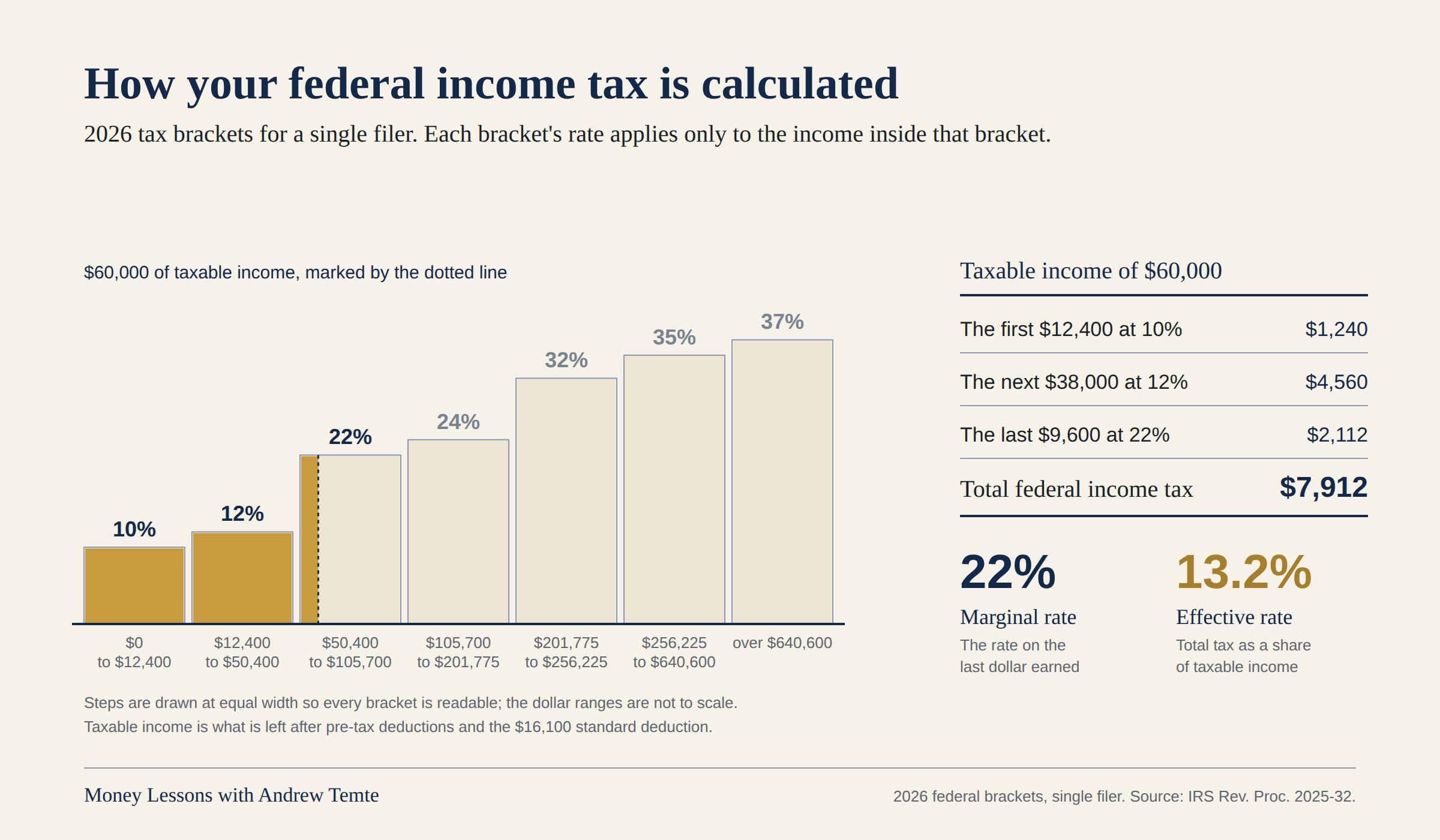
The second term is the tax bracket. A tax bracket is a range of taxable income that is taxed at one rate. For 2026, a single filer has seven brackets. Taxable income from zero to $12,400 is taxed at 10 percent. Taxable income from $12,400 to $50,400 is taxed at 12 percent. Taxable income from $50,400 to $105,700 is taxed at 22 percent. The rates then step up to 24 percent, 32 percent, and 35 percent, and the top bracket, 37 percent, covers taxable income above $640,600. Each bracket's rate applies only to the portion of your taxable income that falls within that bracket.
The third term is the marginal tax rate. Your marginal tax rate is the rate of the highest bracket your taxable income reaches. It is the rate that applies to the last dollar you earn.
The fourth term is the effective tax rate. Your effective tax rate is your total federal income tax divided by your taxable income.
With these definitions set, let's move to an example of how income tax is calculated.
How the Tax Is Calculated
Suppose a single filer has $60,000 of taxable income in 2026. We calculate the tax owed one bracket at a time. The first $12,400 of that income is taxed at 10 percent, which is $1,240. The next $38,000, from $12,400 up to $50,400, is taxed at 12 percent, which is $4,560. The last $9,600, from $50,400 up to $60,000, is taxed at 22 percent, which is $2,112. Add the three pieces together, and the total federal income tax is $7,912.
This person's marginal tax rate is 22 percent, because $60,000 falls in the 22 percent bracket, the one that runs from $50,400 to $105,700. In contrast, this person's effective tax rate is $7,912 divided by $60,000, which is about 13 percent. So someone in the 22 percent bracket pays about 13 percent of their taxable income in federal income tax. That gap is what the two terms are for. Marginal tax is the rate on the last dollar earned, whereas the effective rate is the share of your total tax compared to your taxable income.
Now suppose this same person gets a $5,000 raise, and taxable income goes from $60,000 to $65,000. Only the new $5,000 is taxed at 22 percent. The first $60,000 is taxed exactly as it was before. Many people believe that a raise can push all of their income into a higher bracket and leave them with less after tax than they had before. That belief is wrong, as far as the federal income tax is concerned, because each bracket's rate applies only to the income inside that bracket. If it helps, picture the brackets as a staircase. Your taxable income fills the bottom step first, then the next, and your marginal rate is the highest step you reach. A raise adds dollars on the top step. It never moves the calculations below it.
How Your Employer Estimates the Tax
Now, back to the pay stub. Your employer does not know what your taxable income for the year will be, so it estimates your income tax every payday. Three things go into the estimate: your pay for this period, how often you're paid, and the Form W-4 you filled out when you were hired. The IRS publishes withholding tables every year, and your employer's payroll system runs those three inputs through the tables to calculate your estimated income tax for that pay period. That estimated tax comes off your gross pay, goes to the IRS, and shows up on your stub as federal income tax withholding. Unless your W-4 says otherwise, the estimation process assumes that you have only one employer, that your pay stays steady all year, and that you'll take the standard deduction.
The tax you end up paying is calculated once a year, on your tax return, normally due April 15th of the following year. The return calculates the tax on your taxable income, bracket by bracket, the way we just did, and then compares that tax with the total your employer withheld during the year.
Fun fact, the system your employer uses dates from 1943, in the middle of the Second World War, and it was designed by a small group of Treasury economists that included a young Milton Friedman — the same Friedman who later won the Nobel Memorial Prize in economics and spent a career arguing for smaller government.
The Refund Is Your Money Coming Back
If your employer withheld more than the tax you owe, the IRS sends the difference back to you, and that payment is your refund. If your employer withheld less, you pay the difference when you file your return, and that payment is called a balance due. Most people land on the refund side. Through May 8th of this year, the IRS had sent out about 99 million refunds for the 2025 tax year, averaging $3,276 each, and roughly two out of every three returns filed got a refund.
A refund feels like a windfall. It is not. Every dollar of a refund that comes from withholding is a dollar that was yours in the first place, taken out of your paycheck during the year, held by the Treasury, and returned to you without a penny of interest. The money withheld from your January paycheck doesn't come back until the following spring, more than a year later. Said differently, a big refund means you made an interest-free loan to the federal government, and the government took you up on it. Add up all of those refunds and the total comes to about $325 billion — most of it money that American taxpayers had lent the federal government during 2025, interest free.
The W-4: The One Form You Control
Which brings us to the one part of this system that you control: the Form W-4. The W-4 is the IRS form you give to your employer, not to the IRS, and it tells the payroll system how to set your withholding estimate. The form asks a handful of plain questions about your situation — whether you hold a second job, how many dependents you have — and gives you a place to add a flat extra dollar amount to be withheld from every paycheck.
Two things make the W-4 different from the elections we covered last Saturday. First, you can hand your employer a new W-4 at any time. There's no open enrollment window, and your employer must put the new form into effect. Second, the IRS has a free tool on its website, the Tax Withholding Estimator, that walks you through your pay stubs and last year's return and tells you what to put on the form. The arithmetic is done for you, and I've put the link at the bottom of today's post.
What This Means for You
There are two things to focus on from today's episode. First, when a raise comes, take it, because only the dollars that land in your highest bracket are taxed at the higher rate. Second, look at your refund with fresh eyes. On August 29th we talked about defaults — a default is what happens if you do nothing — and your withholding is one of the largest defaults in your financial life, set by a form you filled out on your first day and probably never looked at again. A large refund every spring is a sign that the default is set high. Now, some people like a large refund, and I understand the allure. If a big refund is how you save for a vacation or another large purchase, and you chose it on purpose, the cost is the interest you didn't earn, and it's not a use of the system I'd advocate for. Prudent financial management of your personal economy is to align your tax withholding to your tax due as closely as possible. The bigger problem is when the large refund isn't a choice at all. So here's your homework this week: put last spring's refund, or the balance you had to pay, next to the amount being withheld on your pay stub right now. If the two are far apart, run the IRS Tax Withholding Estimator and hand your employer a new W-4. Withholding is a setting, and you're the one holding the dial.
Next Saturday we look at the money your employer spends on you that never appears on your pay stub: its share of your health insurance premium, its half of your Social Security and Medicare taxes, and the retirement match. Add it all up and you get your total compensation — what your job is worth, not just what it pays. Benefits are pay.
Until next week... Grace. Dignity. Compassion.
IRS Tax Withholding Estimator: https://www.irs.gov/individuals/tax-withholding-estimator