
Benefits Are Pay: Total Compensation and the Employer Match
I'm Andy Temte and welcome to Money Lessons! Join me every Saturday morning for bite-sized lessons that are designed to improve financial literacy around the world. Today is September 26, 2026.
Two weeks ago we read a pay stub line by line, and I said that your pay stub understates what your job pays you. Last Saturday I promised that today we'd look at the money your employer spends on you beyond your gross pay: its share of your health insurance premium, its half of your Social Security and Medicare taxes, and the retirement match. So what is your job worth once all of that money is counted? Today we'll define the terms we need, follow one employee through all three of those payments, and add up the total.
Three Terms We Need
Let's start with three definitions.
The first term is total compensation. Total compensation is your gross pay plus the value of the benefits your employer pays for on your behalf, such as health insurance and money added to a retirement plan.
The second term is the employer match. An employer match is money your employer adds to your retirement plan account because you contributed money of your own. The percentage of your pay that you put into the plan is called your contribution rate. Every employer match follows a formula. The formula has two parts: how much your employer adds for each dollar you contribute, and the percentage of your pay at which your employer stops adding.
The third term is vesting. The IRS says that vesting in a retirement plan means ownership. The money you contribute yourself is always yours. Your employer's match may be yours right away, or it may become yours over several years on the job. The timetable your plan follows is called a vesting schedule. If you leave the job before you're fully vested, you give up the part of the match that hasn't vested. We'll cover vesting schedules when we reach retirement accounts later in this series.
With those three terms defined, let's follow one employee through the benefits.
The Employer's Share of Your Health Premium
Suppose an employee earns a salary of $50,000 a year and is enrolled in the employer's health plan, with coverage for the employee only.
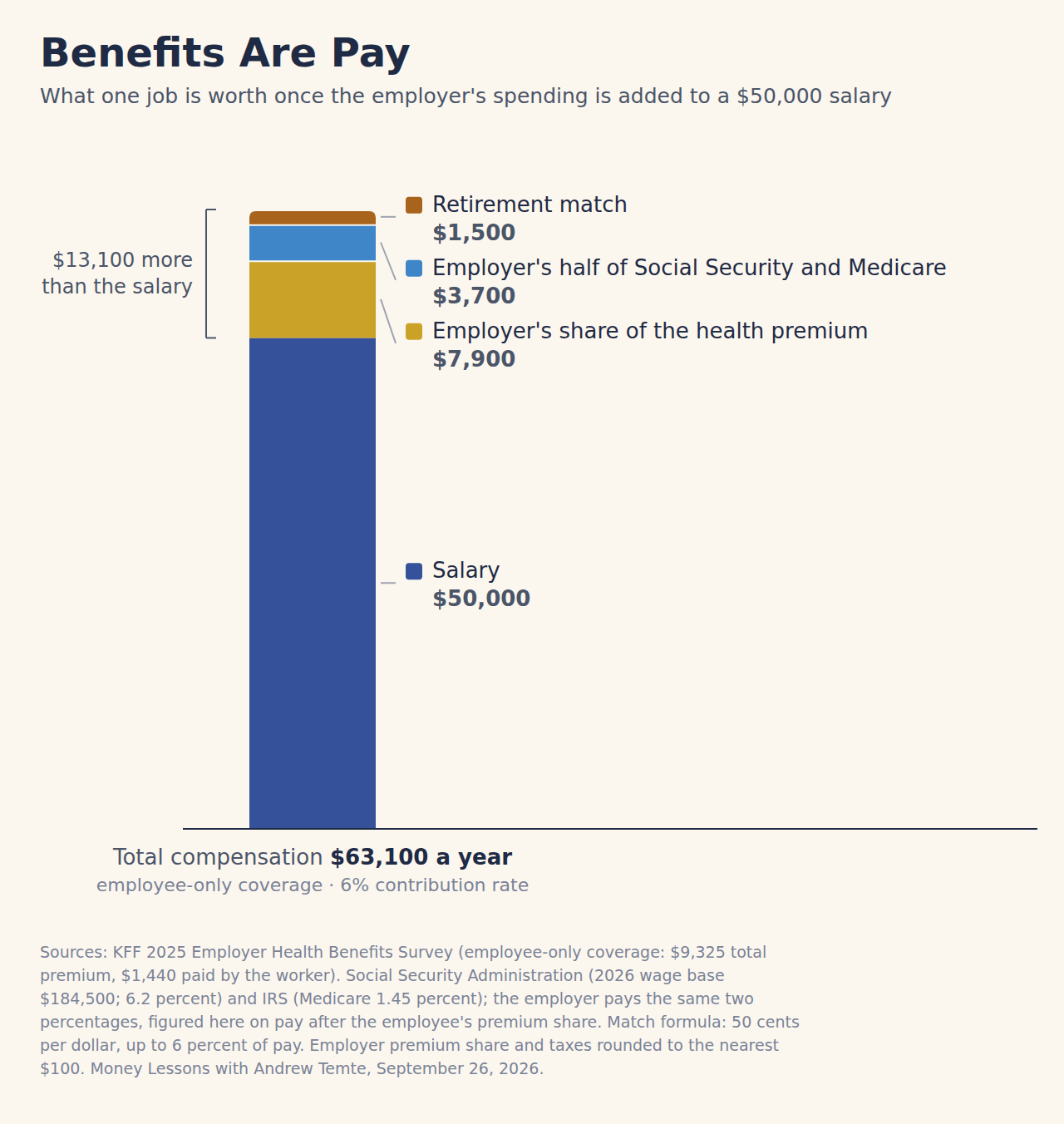
The first benefit is the employer's share of the health insurance premium. Two weeks ago we saw your share of the premium on your pay stub as an elective deduction. Your employer pays the rest of the premium, and the employer's share never passes through your gross pay. How large is the employer's share? KFF, a nonprofit that researches health policy, surveys employers every year. In KFF's 2025 survey, for coverage of the employee only, the average employee paid about $1,400 of the annual premium, and the average employer paid about $7,900. For family coverage, the average employer paid about $20,000. We'll give our employee the averages: our employee pays $1,400 toward the premium, and the employer pays $7,900.
Fun fact, the cost of your own health coverage is printed on your W-2, the form your employer sends you every January reporting your pay and the taxes withheld. Box 12 may show an amount next to the letters DD, and that amount is the total cost of your health coverage for the year, your share plus your employer's share.
The Employer's Half of Social Security and Medicare
The second benefit is your employer's half of your Social Security and Medicare taxes. Your pay stub shows your half as two lines: Social Security tax at 6.2 percent of your pay, and Medicare tax at 1.45 percent. Your employer pays the same two taxes on your pay, at the same percentages, out of its own money. Two weeks ago I said that the Social Security tax stops at a yearly wage limit. For 2026 that wage limit is $184,500, and the employer's 6.2 percent stops at the same wage limit.
The two percentages together come to 7.65 percent. As we covered in the pay stub episode, your share of the health premium comes out of your pay before these two taxes are figured. So for our employee, the $50,000 salary minus our employee's $1,400 share of the premium is $48,600, and 7.65 percent of $48,600 is about $3,700. That $3,700 is what the employer pays in Social Security and Medicare taxes for the year.
Why count a tax your employer pays as part of your pay? Your employer owes its half of those taxes only because you work there, and the money goes to the same two programs that your own Social Security and Medicare taxes fund. A self-employed person has no employer, so a self-employed person pays both halves of the Social Security and Medicare taxes. We'll cover self-employment next Saturday.
Your employer may pay for other benefits too, such as life insurance, disability insurance, and deposits into your health savings account, and we'll cover those when we reach insurance later in this series. The main point so far is that every one of these benefits is money your employer spends on you, and none of that money passes through your paycheck.
The Match: Pay You Collect Only If You Contribute
The third benefit is the employer match. Our employee receives the first two benefits without doing anything more. The match is different: the employer pays it only if our employee contributes to the retirement plan.
A common match formula is 50 cents for every dollar you contribute, up to 6 percent of your pay. For our employee, 6 percent of $50,000 is $3,000. If our employee contributes $3,000 over the year, the employer adds 50 cents for each of those dollars, which is $1,500. That $1,500 is the full match. Our employee can contribute more than $3,000, but the employer's match stops at $1,500.
How does an employee end up collecting less than the full match? One common way is a default. On August 29th we talked about defaults — a default is what happens if you do nothing — and the example was the retirement plan that signs you up automatically. When a plan enrolls you automatically, your employer also picks your starting contribution rate. Vanguard, which administers retirement plans for nearly five million workers, reported in 2026 that about two-thirds of the plans with automatic enrollment start employees at a contribution rate below 6 percent.
Now suppose our employee was enrolled automatically at a contribution rate of 3 percent and never changed it. Three percent is half of the 6 percent that the formula will match, so our employee collects half of the full match: $750 instead of $1,500. The other $750 goes uncollected every year that the contribution rate stays at 3 percent. The point I'd like you to focus on is that the default got our employee into the plan and still left half of the match uncollected.
If your employer doesn't offer a retirement plan, or offers one with no match, we'll cover saving for retirement on your own when we reach retirement accounts later in this series.
The Total
Now let's add up what our employee's job is worth. The salary is $50,000. The employer's share of the health premium is $7,900. The employer's half of the Social Security and Medicare taxes is $3,700. The full match is $1,500. Add the four amounts together, and our employee's total compensation is $63,100. That total is $13,100 more than the salary. If our employee stays at the 3 percent default, the total is $750 lower.
The Bureau of Labor Statistics measures what employers across the country spend on compensation. In its report for June 2026, for workers in private industry, wages and salaries made up 70 percent of what employers spent, and benefits made up the other 30 percent. The Bureau counts more benefits than we counted today, including paid vacation, paid holidays, and bonuses. Said differently, for every 70 cents a private employer pays in wages, it spends another 30 cents on benefits.
What This Means for You
There are two things to focus on from today's episode. First, your job is worth more than your salary. When you compare a job offer with the job you have, compare total compensation: the salary, the employer's share of the health premium, and the match. Two jobs with the same salary can pay very different amounts.
Second, the match is pay you have to collect. Prudent management of your personal economy is to contribute at least enough to collect the full match. Now that you know the match is there, leaving part of it uncollected is a pay cut you volunteered for. So here's your homework this week. Find your retirement plan's match formula. Your HR department or the plan's website will have the formula. Then find your own contribution rate on your pay stub or on the plan's website. If your contribution rate is below the percentage in the formula, raise it. If you can't reach that percentage right now, get as close as you can, because every dollar you add below that percentage brings match money with it. You can usually change your contribution rate at any time of year, without waiting for open enrollment. And while you're looking, check the vesting schedule, so you know when the match becomes yours to keep.
Benefits are pay. Know what yours are worth, and collect the full match.
Next Saturday we cover earning without a pay stub: self-employment, contract work, and the side gig. We'll look at what changes when no employer withholds your taxes, pays half of your Social Security and Medicare taxes, or offers you benefits.
Until next week... Grace. Dignity. Compassion.