Your Personal Economy: The Six Jobs Your Money Has
I'm Andy Temte and welcome to Money Lessons! Join me every Saturday morning for bite-sized lessons that are designed to improve financial literacy around the world. Today is August 8, 2026.
Last week, we closed the book on our long journey through the world of equity, and I asked you to remember the main punchline: over a lifetime, the market has rewarded the patient owner far more reliably than the clever trader. I also told you where we're headed next — to the money that runs through your own life. How you earn it, spend it, borrow it, and hold on to it. Today, that work begins. This is the first episode in a new series on personal financial management, and we're going to start by drawing the map.
A Small Economy of Your Own
Here's the frame for everything that follows: you run an economy. It might be an economy of one, or it might include a partner, kids, and a dog with a vet bill. Either way, money flows in, money flows out, and your decisions steer the flow. Countries measure and manage their economies. Families can too. Whether you run yours on purpose or let it run on autopilot, you're the one in charge.
And your small economy operates inside a very large one that wants something from you. In the United States, household spending — the money ordinary people hand over for goods and services — makes up about 68 percent of everything the economy produces in a year. That figure comes from the Bureau of Economic Analysis, the federal agency that measures the U.S. economy. Sit with that for a moment: more than two out of every three dollars of economic activity in this country happen because somebody like you decided to spend.
So it's no accident that spending is easy. Businesses compete hard for their share of your paycheck, and they've gotten remarkably good at the contest — advertising that follows you across the internet, checkout that takes a single click, payment methods that never ask you to feel the cash leave your hand. None of that is a conspiracy. It's simply how a consumer-driven economy works: the economy grows when you spend, so nearly everything around you is designed to make spending effortless.
That's the balancing act at the heart of this whole series. Spending isn't the enemy — spending is groceries, and rent, and birthday presents, and living your life. But building wealth means keeping some of what flows in and putting it to work. Personal financial management is the discipline of doing both at once: participating in the big economy around you while steadily building a strong one of your own.
The Six Jobs Your Money Has
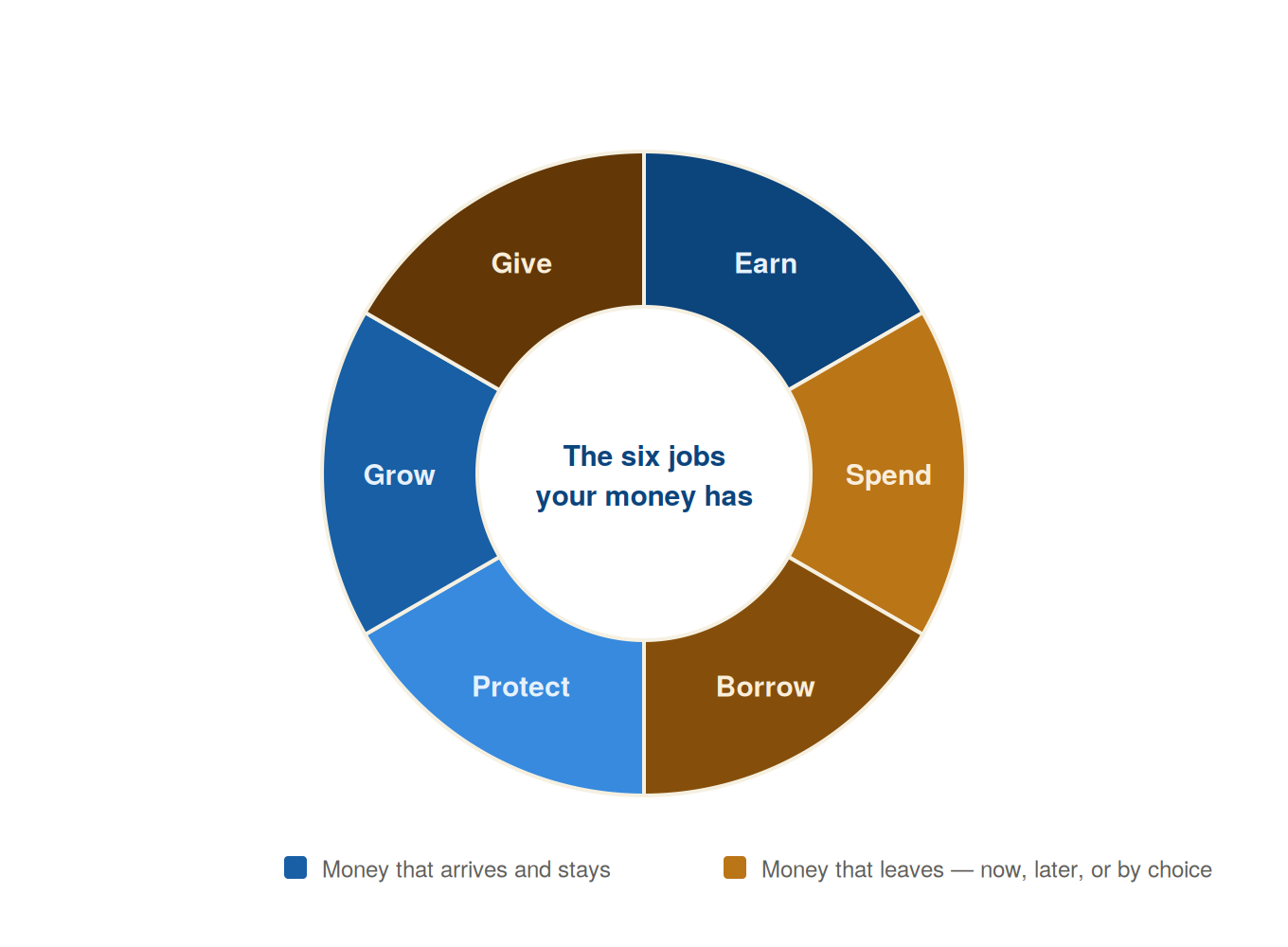
Last week I named four of the jobs your money does — you earn it, spend it, borrow it, and grow it. Today I want to hand you the map in full, and I'm adding the two jobs that get skipped most often—protect, and give. The full map is: earn, spend, borrow, protect, grow, and give. So let’s start at the top.
First, money arrives into your personal economy — that's earn. A paycheck lands in your account, a customer pays your invoice, a side gig pays out. Earn covers two things: the size of what flows in today and, just as important, how that amount increases over your working life.
Second, money leaves your personal economy, and you choose what leaves — that's spend. Rent gets paid, groceries get purchased, a subscription quietly renews. Every dollar that leaves your economy left because of a decision — including the decisions you don't remember making.
Third, sometimes you spend money you haven't earned yet — that's borrow. You carry a credit card balance, sign a car loan, take on a mortgage. When you borrow, you spend today and pay the money back later, out of future paychecks — and borrowed money comes with a price: interest, which we introduced back in 2025.
Fourth — and this is the first new job — you defend what you've built. That's protect. An emergency fund sits ready so a job loss or a busted transmission doesn't turn into credit card debt. Insurance premiums get paid so a single hospital bill can't undo ten years of good decisions. Protect is the least exciting job on the map, and it's the one that keeps all the others standing.
Fifth, what remains after spending gets put to work — that's grow. Savings get deposited and earn interest, investments get purchased and held, and the compounding engine we spent the late summer of 2025 studying starts running in your favor. Grow covers everything from the interest on a savings account to the stocks and bonds you own — this is the job the equity series was preparing you for.
And sixth — the other new job — you give some of it away. That's give. Money, time, or skill, directed beyond your own walls — to family, to neighbors, to causes you believe in. Give sits on this map on purpose: a personal economy that only ever takes in was never the goal.
Earn, spend, borrow, protect, grow, and give. Six jobs. Every dollar that ever passes through your hands is doing one of them.
Stewardship, Close to Home
There's a word I want to plant in this first episode, because it will follow us through the whole series: stewardship. A steward takes care of something held in trust, with the aim of handing it on in better condition than they found it. We tend to reserve the word for big things — the planet, a company, a family farm. I want you to bring it closer to home. Managing your money is stewardship of your own small economy, held in trust for your future self and for the people who count on you.
Stewardship also changes the questions you ask. An economy on autopilot asks, "Can I afford this payment?" A stewarded economy asks, "Is this the job I want this dollar doing?"
What This Means for You
So what does all of this mean for you?
It means you're already the head of an economy. The only open question is whether it runs on purpose or on autopilot. Back in March of 2025, early in this show's life, we drew a line between two destinations: financial security, which means having enough savings or income that money worries don't run your life, and financial freedom, which means having enough resources that work becomes a choice rather than a requirement. The six jobs are how you travel from one to the other, and the series ahead is about making each job — earning, spending, borrowing, protecting, growing, and giving — a little more deliberate than it was the week before.
Here's your only assignment for this week: watch the flow. Don't build a budget. Don't open a spreadsheet. Each time money arrives or leaves — a paycheck deposited, a card tapped, a bill autopaid — pause for two seconds and name the job that dollar was doing. Earn, spend, borrow, protect, grow, or give. Awareness comes before change, and naming the flow is where awareness starts.
You are the steward of a small economy. Run it on purpose.
Next week, we pick up the tool this whole series turns on: decisions. Wealth is built — or leaked — one decision at a time, and your brain uses shortcuts that steer those decisions without asking your permission. We'll meet the biggest of those shortcuts, including one that sits underneath most of the money traps we'll encounter this year: the tug-of-war between your present self and your future self.
Until next week... Grace. Dignity. Compassion.